
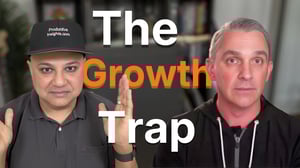
The Growth Trap That Nearly Destroyed a $30M Business
Did you know your business could be growing fast — while you’re quietly going broke?
In this eye-opening conversation, Ryan Deiss shares how he scaled three companies to the Inc. 500 list… but two of them eventually collapsed. He opens up about the painful moment he lost $2 million in a single month and had to lay off 180 employees just weeks before Christmas.
This episode breaks down the real truth behind business “success,” including: Why revenue growth doesn’t equal business health, the key difference between profit, cash flow, and distributable cash, Ryan’s Cashflow Waterfall system for building a sustainable business and how to stop chasing vanity metrics and start building real wealth.
Timestamps:
0:00 Growing broke while revenue grows
0:27 Inc. 500 success → business collapse
1:00 Why profit matters more than revenue
1:23 The trap of vanity metrics
1:59 Distributable cash = real business health
2:54 Choosing sustainability over hustle
4:38 The $30M company that lost $2M
6:01 Cashflow Waterfall explained
7:08 Why taxes come first
8:02 Emergency fund (3–6 months)
8:55 Distribution fund strategy
10:00 Why you must pay yourself
12:08 How this connects to Profit First
12:33 Profit is a decision
13:35 Closing
Ash Roy and Ryan Deiss Video Transcript (This transcript has been auto-generated. Artificial Intelligence is still in the process of perfecting itself. There may be some errors in transcription):
Ash Roy: Did you know that your business could be growing by millions of dollars in revenue and you could still be growing broke?
Ryan Deiss: We're high fiving as a company only to realize that that same month we lost almost $2 million.
Ash Roy: There's ahidden cost that's rarely discussed. Most businesses are so busy chasing revenue that they're hemorrhaging cash.
Ryan Deiss talks about how he faced this challenge and solved it. Using his waterfall technique, which he shares in this video.
Ryan Deiss: So within six months of appearing on the Inc. 500 list, we had to walk into a room and let 180 people know a few weeks before Christmas that they weren't gonna have a job in the new year.
Ash Roy: So if you are tired of chasing vanity metrics and you're ready to build a calm business that brings in steady cash flow, then this video is for you. None of this should be construed as financial advice. I'm gonna cut that out. I'm just,
Ryan Deiss: no, leave it in. It's fine. I did it. It's fine. Um,
Ash Roy: let's do this, Ryan, you've scaled multiple businesses above $10 million.
Now we see a lot of marketers talking about million dollar this, million dollar that, but something I've also noticed is they talk about top line revenue numbers and putting on my CPA hat, I know that profit is more important than revenue, and cashflow is more important than profit. So could you talk to us about that aspect of building and growing a business?
Ryan Deiss: Sure. I mean, if there's one thing business owners are famous for, it is talking about vanity metrics that impress other business owners but that don't actually matter to their bank account. So whether you're talking about top line profit or you're talking about the number of employees you have, which is one of the stupidest ones ever, um, or, you're talking about the size of your email list.
These are all just vanity numbers that we as business owners like to throw around. But yeah, the thing that makes the difference at the end of the day, is it revenue. It's really not even profit. Uh, it's really not even cash flow. It's how much distributable cash is actually able to leave the business and go into your pocket.
Now I get why people don't necessarily talk about that. Uh, that can be kind of a personal, uh, thing, but I'm all about business owners talking about taking lots of money outta their business. I think it's a good thing, and I think the ultimate sign of a healthy business is not revenue. It's not p and l Profit.
'cause P and Ls like to lie. You as an accountant know this better than anybody else. It's not even like NPS, like Net Promoter Score Customer satisfaction. The ultimate sign of a healthy business is that company's ability to distribute large chunks of cash to its stakeholder. That's the sign that you're creating excess surplus value.
Uh, and so that should be the goal of every business owner.
Ash Roy: Now that's a lot harder than it would seem. I've been in business for 12 years now and I reinvested a lot of my profits back into the business to drive growth. How do you walk that path of not reinvesting all your profit back to drive growth?
Ryan Deiss: I think step one is to do exactly what you said and to decide that that is a viable option, because I think a lot of businessowners don't actually.
Make that intentional decision. We're sort of taught by the media and, and we're sort of taught by the Elon Musk and the examples that we see out there that the job of a business owner is simply to grow the company as big as you possibly can. Um, and, and we see this out there just in hustle culture. It shows up.
So your job is just to go, go, go. Um, we also see this funny enough in the opposite end of the spectrum, so these people who are all about,oh, you need to have a company that's very mission driven and it's all about the mission, right? And, and, and you know that, that now becomes this, you know, really almost religious type thing where your job is to kind of martyr yourself.
For the business. So the first thing that you've gotta decide is that neither of those things are true. You're starting your business first and foremost, to create a better life for you and, and, and your stakeholders. And, and I, and I firmly believe that. I believe that that is the, the role of business and, and yep.
It, it should create a great job for the employees. Yep. Hopefully you're making a dent in your little corner of the universe. A positive dent, of course, but. I, I've never seen water flow from an empty cup, and I've never seen a broke person hire another broke person. Right? We have to make money if we're going to keep this thing going.
And I can tell you I experienced this firsthand, roll back the clock to 2016. I had not one, not two, but three companies simultaneously onthe 500 list of fastest growing companies in North America. It sounds reallycool. When I go and speak on stages, I'll get introduced as a multi Inc 500founder.
Here's the other side of the story that people don't find out about. Two of those three companies failed. They completely failed, and the reason they failed is because they grew really fast in revenue. So fast that they lost money. And, and so this idea, one, one company in particular did halfa million year, one 3 million year, two 30 million in year [00:05:00] three.
Ash Roy: Wow.
Ryan Deiss: Made the INC 500 list we're high fiving as acompany, only to realize that that same month we lost almost $2 million.
Ash Roy: Oh my goodness.
Ryan Deiss: We weren't a mega funded company and, and solosing $2 million was not good. So we're like, oh, we need to turn this thingaround. Well. We didn't get it turned around fast enough.
So within six months of appearing on the Inc 500 list, we hadto walk into a a, a room and let 180 people know a few weeks before Christmasthat they weren't gonna have a job in the new year. Again, we were all aboutgrowth, growth, growth, and we weren't about building a sustainable business.So I think the first thing that you have to do is just decide that.
I'm going to build a sustainable business. I'm gonna build abusiness that creates excess value, that distributes cash. Not because I'mselfish, but because it's the sign of a healthy business. Now, tactically, howyou go about doing this, um, uh, what I created in all my [00:06:00] business is something that we call a flowwaterfall.
'cause again, I'm all about the cash p and l matters. I'm allI, I love, I love my income statements, and I love my balance sheets. Okay. Ithink they're great, but here's what I'm really looking for. When we set up anew business, we're gonna have a, an operating account, and, and that's just abasic checking account.
Everything's gonna pour into that singular operating account.What we're going to decide as a team is how much do we need to keep in thatoperating account at any given time? And for the most part, the number's aboutone x, you know, one month opex. So, however, however much it costs you to keepall the lights on, to get everybody paid to run the business, buy the ads, how,however much that costs, we wanna try to build that up just in that account.
That's kind of job number one, is to make sure that in thataccount we can survive for next month. Now everything over and above thatamount. It is gonna waterfall down. Now, one of the first things that's gonnawaterfall down is [00:07:00] taxes. And I gottatell you, pay your taxes. You only have one vendor that has missiles and canput you in jail, okay?
And that vendor is the government, whether it's the USgovernment or the Australian government, or wherever your jurisdiction is, payyour freaking taxes. Um, so they get theirs first. And we put that, we siphonthat off into a separate account. So talk to your CPA, figure out how much thatneeds to be. But you need to be setting that aside in that account.
Do not touch it. Don't invest that in Bitcoin. Don't invest itin anything. I don't even like putting in a fricking money market. Okay? I justwant it there in cash. 'cause I want to get it gone quarterly. That sucker'sgonna be going somewhere. It ain't my money. So that's going in a separateaccount now.
Everything else again over that one month. Opex. Now I want to.Waterfall into a separate fund that is our emergency fund, that is the savingsfund, that's that rainy day fund. And for most of our businesses, we wannabuild that up to about a three month fixed expenses. [00:08:00]So not total operating expenses, but just fixed.
So now we're not buying ads and stuff like that. We're notdoing anything extraordinary, but just covering payroll, making rents andutilities, those kind of things. So if you think about it, between that andthe. Main checking account. We got about four months worth. For somebusinesses. If they're a bit more seasonal, we might push it to six months, butI don't like to keep that much more in cash because what I know I can do is Ican go to any bank, I can get a line of credit that is backed by that three monthsthat's secured by that, and now I've basically doubled it to six months.
Mm-hmm. In terms of my cash available now, everything overthat, once that is full. Is gonna waterfall down into either a specificinvestment account for future investment. So you said how do we make sure thatwe're leaving money in for future investment? It's really simple. It getsbudgeted for meaning it, it occupies a, an expense item on the chart ofaccounts On the PL.
Mm-hmm. Or it gets planned for, we want to [00:09:00] do a major equipment purchase. We got abig event that we need to save for. Fine. We're going to create a separateaccount. That is earmarked for that, and we're gonna allow some money to flowinto that. If we don't have that, or if that is full, we have another accountthat is the distribution fund and everything that flows into that distributionfund.
That's the account that I'm looking at. And if that accountisn't getting bigger, there's a problem. And then what we do once a quarter iswe distribute 80%. Of whatever is in that account. Pro rata to thestakeholders. And if people are saying, oh, but we wanna leave some money inthe account to invest, my solution is simple.
Great, let's distribute it out. And then if you want to put itback in, we can put it back in. But something magical happens when you take themoney out. You start thinking really, really, really hard. About what? What itmeans to put it back in. Right. You start getting a lot more intentional.'cause in the past, man, we would just leave the money in the account and itwould just have a way of [00:10:00] going,going somewhere.
And I'll tell you, an optimistic entrepreneur's ability tospend will always outpace their ability to earn.
Ash Roy: Absolutely. Great.
Ryan Deiss: Always. So you've gotta take it out. Gottatake it out.
Ash Roy: Okay. Thisis great. Great. Advice. Now, something I I am probably legally required to sayis none of this that Ryan is saying, or that I'm saying should be construed asfinancial advice.
You must speak to your financial advisor. We are only talkingabout our experiences. I am A CPA, but I am not practicing and I'm not yourCBA. So please keep, I'm
Ryan Deiss: talking to you right now, Kevin. I wantKevin, you know who you are. Go buy Tesla stock. I'm just kidding. That's ajoke. We're giving individual investment advice.
We're gonna completely throw caution to the wind. If you're, ifyou're a Kevin out there listening to this, that was a joke. Please the love ofGod. Don't do what I said.
Ash Roy: I'm gonna cut that out. I'm just kidding.
Ryan Deiss: No, leave it in. It's fine. I did it. It'sfine. Yeah. Um, I, funny enough, I was actually, the only job I [00:11:00] had was, um, was a, a registeredinvestment advisor.
So I actually completely know what you're, uh, allowed to doand not allowed to do still.
Ash Roy: Right,
Ryan Deiss: right. Um, and I know that you're notallowed to do that.
Ash Roy: Yeah. So look, I think that's such a goodpoint, Ryan, that as entrepreneurs we tend to really press, uh, put our footdown on the accelerator and don't even think about the brakes equally.
The reverse is also true, where if there isn't enough cash flowor cash in the bank, we can go into these really dark places in our minds andit can kill the, the enthusiasm or the the drive that we have. So it's a bit ofa fun balance, isn't it, to be able to have enough cash flow. Make sure that wehave money to pay our taxes and money to pay our operational expenses and soon.
But yet also make sure that there is enough cash for us to feela certain sense of abundance and [00:12:00]optimism. Um, by the way, so a lot of the stuff that you talk about is alsotouched on in the book Profit First, which is a great book and I read it out.
Ryan Deiss: Yeah. Mike Mcal, I was gonna say Mike, MikeMitz is a good buddy of mine.
I, I had been doing the, the Cashflow Waterfall and I read hisbook. I was like, haha. You stole it from me. And he's like, I wrote this longbefore, and I was like, I know, I'm just screwing with you. Um, so yes,completely agree and, and what, 'cause people will say, this is a greatconcept, but I don't have enough profit to waterfall down.
And my comment is always the same. You have to decide ahead oftime what your profit is going to be,
Ash Roy: right?
Ryan Deiss: Profit doesn't just magically happen. Profitis a decision. And so as a business owner, you have to decide what your profitis going to be and work backwards from that. Certainly once you're beyond justkind of the initial product market fit stage, when you're still trying tofigure out what am I selling and what are, you know, who am I selling it to?
And you're doing that like, yeah, I mean, you're probably notgonna be profitable. You don't deserve to be profitable 'cause you're notcreating excess value yet. [00:13:00] But onceyou are beyond the, the product market fit stage, you're beyond that initialpoint of traction. You're selling to somebody other than like your mom and yourold college roommate.
It, you really should be profitable. That's a sign that you'recreating surplus value, but you have to decide to be profitable. And so, andwe're gonna put a minimum 20% profit on there. Like, let's just figure it outand work backwards from that. So who can we hire? And I'll tell you, man, withAI and stuff like that, now it's gotten easier than it was before, uh, to hitthat number.
Ash Roy: Okay. Great. This is a great jumping off pointfor ai. Okay, so that was the end of the first part of my ongoing series withRyan Dice. Be sure to subscribe to learn how Ryan Dice is using artificialintelligence. And turning AI into an employee that's coming up next. If youfound this useful, please do consider sharing it with somebody else.
And if you'd like to watch the full conversation with Ryan Deisright [00:14:00] now, then consider joining ourYouTube membership where we release early access to our members. And this videohas been in the membership now for almost four weeks. So I'll see you insidethe membership by for now.