

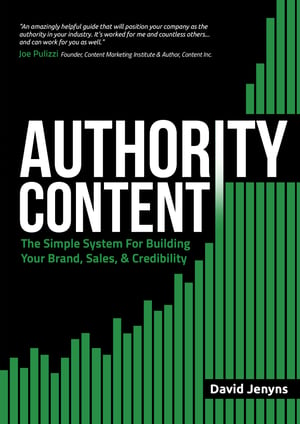
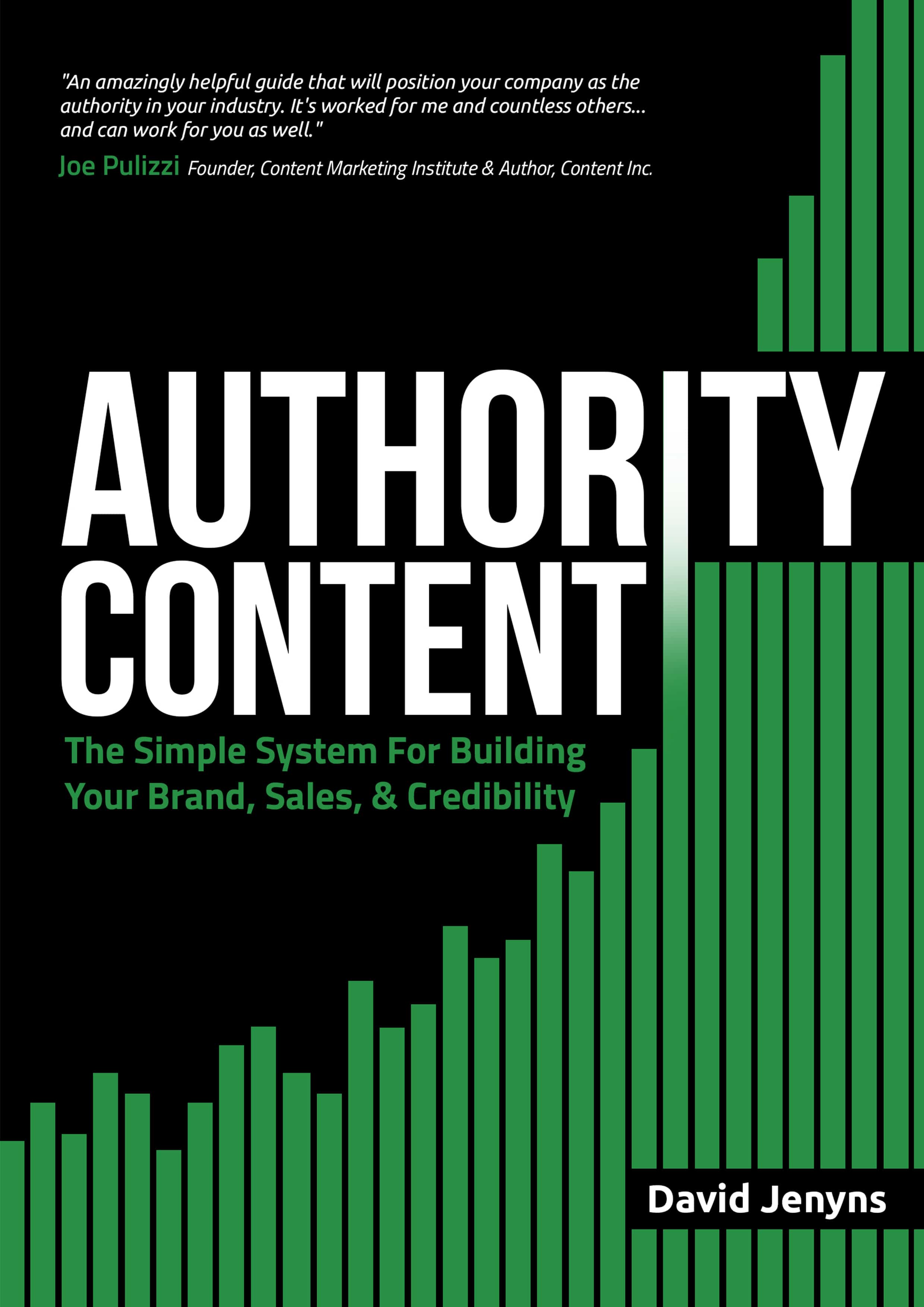
David Jenyns On Authority Content: Turn One Talk Into Months Of Content (Part 2 of 2)
Read how a Sydney strata lawyer used a podcast to become the obvious choice in her field: How independent professionals use a podcast to win better clients.
Then work out what one new client is worth to you: What is one client worth to you?
Short answer
In part 2, David Jenyns says one recorded talk can feed months of content. Record on video first, because the video, the audio and a transcript give you three formats from one session.
He says to treat his method as a framework and make it your own, then stick with it for a long time. His own book came from a one-day workshop that was transcribed and given to a ghostwriter for the first draft.
Key takeaways
- One talk can be the seed for a year: David says Troy Dean ran a "101 ways" presentation and cut it into articles and short videos. It was his core content for about 12 months.
- Record video first: strip the audio out and get it transcribed. You end up with video, audio and written content from the same session.
- Make the method your own: people who look for a perfect formula, like traders hunting for the perfect system, blame the system when it fails. Learn the building blocks, then adjust them to your audience and your business.
- Publish a lot, then double down on what works: some pieces get three, five or ten times the views of others. Find those and build on them.
- Pick one thing and keep digging: David compares jumping between ideas to digging lots of two-foot holes in a field. Go deep on one method long enough to reach the gold.
 David Jenyns who’s the founder of authoritycontent.com. He started his career in the stockbroking industry, and he went on to build a very successful business called Melbourne SEO Services, and that’s melbourneseoservices.com. This SEO service has evolved into authoritycontent.com which is the direction in which SEO is heading given Google’s insatiable hunger for high quality “.
Related Episodes:
- 029. What Is SEO and How To Integrate It with Your Content Marketing Strategy – with David Jenyns
- 030. How to Use Frameworks to Take Your Business to the Next Level – with Taki Moore
- 075. Joe Pulizzi — Founder of Content Marketing Institute — Does Your Content Fit Into Your Buyer’s Journey?
- 073. Darren Rowse — Problogger Founder — Shares His Secrets Around Prolific Content Creation, Podcasting, & Facebook Live (Part 1 of 2)
- 074. Darren Rowse (Problogger) Shares His Blogging Success Secrets (Part 2 of 2)
- 072. Bob Burg On How To Be A Go Giver And Get Your Customer To Know Like And Trust You
- 038. Rand Fishkin – How To Create Great SEO Friendly Content Plus Key Trends In Search
- 041. Mobilegeddon Is Here! Is Your Site Mobile Responsive? – with Eric Enge
- 080. Podcast Launch Delivers 26 New Leads And 1 New Client Within 6 Weeks To A Successful Legal Practice! [Case Study]
- 006. Chris Garrett (Copyblogger) On How To Use Content Marketing To Win Online (Including A Simple 5 Day Plan To Get You Started In A Week!)
- 023. Content Marketing for Business Success
- 032. Dan Norris on his new book Content Machine (Released 10th Aug 2015)
- 015. Google Adwords Success Secrets Revealed! With Mike Rhodes
- 036. Online Presence, Key Trends In Content Marketing, And What This Means For You — With Yaro Starak
Books Mentioned

Transcript
Machine transcript, lightly edited for reading. Speakers aren't marked. The intro, plugs, giveaway and closing voiceover are left out.
I actually have got a positive constraint that has inadvertently been put in place. My client and friend Amanda Farmer has been speaking at Macquarie Bank in September.
So I love it. I think another great story that comes out of just one presentation.
So if you're recording that and you take that and it becomes the seed piece of content that you ended up, you know, deriving a whole lot of content from that you could use over the next three, six months. I'm working with a guy, Troy Dean.
He manages a WordPress community and he applied authority content very early on. And he ran this presentation.
It was like 101 ways to get more clients or get your clients to pay more or something like that. And he took that content and chopped that up into like 101 different articles, took little snippets of it and used the little videos.
Became the core content piece for about 12 months. And just recently, because I had my book launch for authority content in Melbourne, he cites authority content and this process, this idea as the seed idea that then evolved this business into a million dollar business.
So it all comes from this one idea. And just when you do this presentation from Macquarie, think very clearly about, right, who's my target market?
What's going to be best and most relevant and interesting to them? And think about this, something that's really going to have some longevity.
How can we get your best ideas? I've already got an avatar.
Love it. I'm looking forward to seeing the video.
You want to be recording absolutely everything you do. Do you know Ryan Spanger from Dream Engine?
Yeah. Yeah, Ryan.
We used to work right near our studio. Yeah.
So I had him back on episode 15. I want to get him back on the show too, but he said it really well.
He said that video is the best way to replicate yourself. And it builds trust like nothing else does.
I think podcasting is great. It's very intimate and it builds a lot of trust over time, but video somehow does it faster.
I think podcasting has benefits of a video in some respects. For one, you know, you can consume a podcast in a dead time while you're traveling in the car or at the gym and it's harder to consume video in those situations while it's plain dangerous to consume video while you're driving.
But I think that video does have its benefits. It does provide the ultimate proof, right?
Because we are validating a person with multiple senses, with hearing and with our eyesight. You are creating video content right now and you're creating audio content and you're creating transcription, so written content.
Yes. So I'm of the belief that it's best to just start with video and everybody learns in different ways.
So some people like to read, some people like to listen, some people like to watch. So I think taking your content and delivering it in as many different ways as possible is a good idea.
And I just love starting with video first because I can tick all three bases with one step, where sometimes if you start just with podcasts, so you're quite smart. You also record the video as well.
Some people just do just the audio. That means if they wanted to create video content, they then need to do another step to get that.
So it's much better to lay everything together. That's another sort of real center point for the way that I do what I do.
I always think about how can I get the most out of one activity? Leverage it as much as possible and you just strip out the audio from the video and then you transcribe the audio using Rev.com or one of those services.
And as you said, you've got three mediums or three versions of your content, video, audio, and written. Yep.
And that's authority content, really. It's not just an SEO play.
It's not just a content marketing play. It's not just an authority play.
Like it's very hard to quantify the value of applying this. And sometimes you don't know the benefit until you start and you're a little bit further down the pipe.
I've got people who've benefited at each different stage of the three P's. Someone who ran the event with this little mastermind group that I ran an event at the same time.
And I coached them through that process. One guy I know made a whole bunch of money on that first event.
Another person ended up partnering with a bank and PayPal because he was running an event and he said, Hey, do you want to be a sponsor? Another guy just ran the event at break even and then turned it into a product that he then went to his list and sold.
So he made his money on stage number two. And then I know other people who then made their money in stage number three, the promote stage, because then they took everything, chopped it up, shared it around the web, and then it generated enough traffic that then got them some interest to their service.
So it's at each stage of the process, there is a way to profit and everything is a little bit better. And like some will appeal to different people at different places.
It depends on your business and you slightly customize and tweak it to make it your own. I think that's another thing I learned from being in the stock market education space many moons ago.
And you'd appreciate this because I know you have a finance background as well. When people get started trying to trade online and build trading systems and things like that, they go in the search for what we call the Holy Grail, the perfect system that will tell them when to buy and when to sell and give the maximum amount of profit.
So they go on the search for this Holy Grail and they might start even buying trading systems and, you know, asking gurus, what's the magic number you use for your moving average or which statistic or indicator are you using? And they want the exact formula.
And then if they follow it and then they don't get the result that they're after, then they can then blame the system or the guru. It wasn't their fault.
The people who make trading work for them is they take that strategy that they learn and then they tweak it, they customize it, they make it their own. So then they take ownership over it and the success or the failure of that system comes back to them.
And they're the people that actually end up succeeding because they understand the process at a much deeper level. And they can adjust and move based on what way the wind is blowing and those sorts of things, because the markets change as does business changes.
You can't just have one strategy that you hold on to. And, you know, if you've got a MySpace strategy and you're still pounding that over the head, trying to make MySpace work, the game has changed.
You need to have more of a fundamental foundational system, understand the main building blocks, and then you customize it to suit your audience and your business and what's going on. And that's really what authority content is.
It's the framework that you can then customize and make your own. I love it.
Okay. Well, this brings us to my favorite part, the action section.
So this is where I kind of summarize what we've talked about and you fill in the blanks, if I've missed any, and I'm sure there's going to be quite a few because we've talked about so much stuff. The main takeaways, the main action steps from this episode is understand that content is about getting attention first, then engaging the audience and building trust.
You do that by creating content consistently over time and repeatedly delivering value. You create valuable content by really understanding your audience and create the content around where your audience is at and meet them at their mind space, at their position in the journey.
So if you want to sell swimming pools, you're not necessarily creating content about how wonderful your swimming pool is. You're probably looking at creating content around the decision prior to purchasing a swimming pool.
So you're creating content around questions like what sort of swimming pools are there, there's glass pools, there's concrete, stone pools, whatever. And you're teaching them frameworks around how to decide on the right pool.
That brings up another great point about frameworks. When you take a framework and use it, whether it's in content creation or otherwise, don't just find the holy grail or look for the holy grail with a perfect formula and then expect it to work.
You need to internalize the framework, understand what it means and what various aspects of the framework means, and then apply those aspects as they are appropriate in your current environment. And this is a classic mistake.
A lot of people make when they just copy other marketers or other content creators, when you blindly copy someone, you are going to fall on your face. And it is very apparent when you just blindly copy content, you need to understand the principles and then you need to apply it.
And this applies as much to content creation as it does to building and running a successful business or life. Exactly.
Then the other thing we talked about, which I thought was good from Darren Rowse was having a before and after avatar. So you think about where your audience is before they consume your content, where you want them to be when they finish consuming the content and your content builds that pathway in between.
We talked about having content that is shareable and the way to create content that shareable is to get people to know, like, and trust you against your consistency and what else did I miss? I reckon you hit the nail on the head on most of it.
Like, I think the biggest thing I just want someone to take away from here is they'll feel the excitement coming through this call and I want them to take that and then apply it and stick to a date. That's the real key.
Trust me, if you can create a positive constraint for yourself, that's when you're going to start to see things happen, whether or not you apply authority content or you find another system that's right for you. It doesn't really matter.
The key is to just find something that you resonate with and then follow it all the way through to completion and understand it at a deep enough level that you can make it your own. If you do that, you've got the key message from this podcast and you can come back and thank Ash a little bit later.
And David, there's one more thought I wanted to share before we move to the next section, and that is something Chris Garrett said that I absolutely loved. He said, content marketing is a conversation that is happening out there anyway between a buyer and a seller, whether or not you want to be part of that conversation is up to you.
And that is through content creation. So I really liked how he said that because the truth is content is being created every day and good quality content has been created every day.
The question is, are you going to be part of that conversation? And if you're not, then you're definitely going to miss out on sales.
And this has been happening since the dawn of time. I know everybody thinks, oh, yeah, content marketing, it's all the rage and all the vogue right now over the past few years, it's been rising.
But content marketing has been around for years. I think I was when I was doing my research, I came across a farming company that used to create a journal like a magazine that would teach farmers about how to raise crops well.
And then as they, you know, it was a printed publication that would also reference their products and how to use them and how to get the most of them. Like that is content marketing.
That's offline content marketing. And that was, however many hundreds of years ago.
So it's not a new strategy. There's definitely been changing mediums with the way that online works and that sort of thing.
It has evolved and you need to keep up to date with that. But content marketing as an idea is not new.
You just need to join the conversation and be helpful and useful. And then if you capture your target market at just the right point in time and you're answering their questions, you're now right front of mind when I'm about to make a buying decision.
And now I know, like and trust you, I'll do business with you. I remember Yaro Starak saying something very much along those lines.
And by the way, I'm doing exactly that by talking about all these other episodes. I'm trying to present relevant content to the listeners.
So Yaro Starak is, by the way, episode 36 and Chris Garrett is episode number six. I remember those.
OK, so what books have had the biggest impact on you besides authority content and and why? In fact, what's influenced this book?
Yeah, the biggest influence for the book actually just came from, as I mentioned, I was in the stock market education niche. So I partnered with another guy who created a lot of content and I was more of the marketer.
So I just did this out of I need to find a way to get our message out there because we exhausted our immediate community, but then I needed to extend beyond there. So it really was trial and error.
So that's why it's taken me 10 years to develop this process. And I've just applied it now to hundreds of different businesses, my own and also clients as well.
So there are definitely influences that would have come along the way, for sure. I mean, I was reading some of the classic direct mail guys, everything from Dan Kennedy to Jay Abraham.
Like that all influenced me from an early stage. And then as I moved online, I was looking at some of the guys who've been around for ages like your Yanik Silver and Frank Kern and those types of people come across their material.
But then you kind of evolve and you find your own way. I mean, this kind of leads into your question about which books.
I loved reading jobs that I love biographies. I just finished Elon Musk's biography.
Fantastic. And for me, those books, it's more about motivation and understanding that everybody has their own way.
And it just keeps reinforcing to find my own groove. Because when you read these biographies, you find everybody has found their own way, their own trading system that works for them.
And that comes back to your point about the frameworks. It's about you like understanding the frameworks that these people use.
By reading the biographies, and then you implement your version of it. Yeah.
And I start to think about, well, where does that piece fit in? And does it give me a greater understanding of my own framework?
Can I now think of this framework and approach it from another vantage point, from something I've learned from someone else, which helps me to further round out my thinking on this point. So the idea of authority content, it's going to remain as true and relevant today as it will be in the next 10, 20, 30, 50 years.
Like the actual framework is really, really solid. And what will change is just my understanding.
And maybe platforms will come and go, you know, who knows? Maybe in 20 years, we're not sharing content on YouTube.
It might be somewhere else. But the steps that you go through, that's just one of the platforms.
So for me, it's yeah, I like reading books to give me that motivation. Remind me that I'm on the right track.
Helps me to kind of further solidify my own groove and find my own path and go, yeah, I'm in the right space. I think as far as like any parting words, if this methodology resonates with you, that's the thing.
You just need to follow that and go a little bit deeper, find out, Hey, is there more here that resonates with me? Do your research on me.
Look around, make sure that I am exactly who I say I am and that I walk the walk and you can see all of this back history. And if that feels right, then start to apply it, focus in, turn everything else off, unsubscribe from other emails, just really narrow in on one thing and take it all the way through to completion.
Most people, what they do is they do jump from one opportunity to the next. And if you imagine the idea of a big open field of opportunity, and it's almost like these people are digging for gold and they start digging and they only dig two feet into the ground.
And then they go, Oh, there's no gold here. And then they move over to the next course or whatever it is next idea and start digging again, looking for another opportunity.
And then years go by and they've just got a field full of these two foot holes where they've never really gone deep enough to try and get to the gold. You need to make sure that you find a hole worth digging and then keep digging for a long period of time and then you're more likely to hit the gold.
So if this resonates with you, trust me, go deep with authority content. I've proven it works many, many times.
And I know it'll work for you as well. There is one more thing I wanted to talk to you about David.
And that is, look, I'm going to challenge myself to try and get started with getting in front of a camera. And here I am in front of a camera.
We've made this video. So why the heck not publish it, right?
So if I wanted to publish this video to YouTube, would you recommend publishing it in bits and pieces or publish the whole hour? I believe I wouldn't need to chop it up.
And if so, how do I go about doing that? Yeah, it depends on where you're going to share it.
I think since this is your first time, what I would probably suggest is finding a piece in the video where we share just one really good idea. The key is with any video or any piece of content, once someone's consumed it, you want them to think, huh, that was a good use of my time.
You don't want them to go, Oh, I'm never going to get that two minutes back from my life. So you need to find a really good nugget of an idea and you can chop that down.
That could be anywhere from, you know, one minutes up to let's say 10 minutes. It does depend on the point.
There is no exact sweet spot. In fact, like all things SEO, I actually think it's a good idea to do a variety of different things.
You never want an exact set formula where you say a video must be exactly this length, or you must mention the keyword two times in the title, three times in the description that's looking for that holy grail again, isn't it? Yeah, it's the holy grail.
And not only that, if you do that, set yourself up for a little bit of a risk. What happens if Google changes their algorithm?
And now one particular way of optimizing is less favorable than another. So you're much better off to let it happen organically, have videos of varying different lengths.
And the real key is to try and get a consistent amount of content out. Because if you've got an audience, you'll find that some pieces of content will get three, five, or 10X the amount of views than other pieces of content.
And it might be that you hit the right keyword, or you hit the right message, or it was really shareable, or there are a lot of different factors. But the real key is to put enough good quality content out there, find the bits that float to the top, and then you double down on those bits.
So you might go, oh, wow, that idea worked incredibly well. How do we turn that into a productive insights infographic that I can share?
How can I take that video and upload it to Facebook directly and boost that content and put something in the comments to say, hey, go listen to the rest of this episode back on my podcast over here? It's all about putting enough content out there and then doubling down on your winners.
Cool. Awesome.
Well, I will definitely take action on that. All right.
Well, thanks so much for being on the show, David. It's always a pleasure to talk to you.
And it was awesome talking to you again. And I can't wait to have you back.
And I'd love to hear how this book goes. So let's talk again in a few months and see how the book's going, how the launch is going and how it's affected more businesses in a positive way.
Actually, can I, one final point? Yeah, yeah, yeah.
The authority content really is the final step in this process. It's this is the best example of itself.
So I ran a one day workshop. I got it transcribed.
I gave the transcriptions to a ghostwriter who did my first draft of the book and then I edited it. So authority content, the book, this is the final piece of authority from this process.
So if you think about going through this process and when you run that day workshop or whatever you could. So for your example, for your business, Ash, I know you have a service where you help set up podcasts, a podcast launch service, yes, podcast launch service.
So you could run a one day workshop where you go through the entire process of everything that's covered in your done for you type service. Then what that does is that will be something one you can use internally to train your staff.
Now, when you get new team members, because I know you're, you've got new team members now, I think you're up to about four. Now that team members join you, you can use that as a way to train them.
You can also chop it up into pieces and share it around the web. And that's a great way to demonstrate your authority and explain your process and demonstrate your value, because then the prospect goes, oh, wow, I can see what Ash is doing and I can see he's really adding some value there.
You could then take that transcript and then give that to a ghostwriter and turn it into a book and you could now come out with a book about how to create podcasts for your businesses, and then that becomes a fantastic lead magnet for you to find the high value client that you're looking for. You're looking for someone who already has an established business, someone who's already got a little bit of momentum and they want to find a new marketing angle, maybe with podcasting or something like that.
And a book would be a great way for you to open the door if you're chatting with a lead or if you want to do some online marketing and it becomes the front of your funnel so you could do a free plus shipping giveaway. You get people into the front of your funnel and then you can follow up with your sales process.
So it's one of those things. Once you get the momentum going, I think you'll start to see all of these opportunities open up.
Well, that's great, man. I mean, I really love how you've used that as such a fantastic example.
Two awesome case studies. One is how authority content is the result of your authority content process.
And then you've gone on to explain to me how I can replicate that with a book on podcasting through the whole ghostwriting process. And so I love that.
That really rounds things off beautifully. So thank you so much for being on the show.
Can't wait to have you back, man. Pleasure.
Thanks again, Ash. Really appreciate what you do.
You're welcome.