

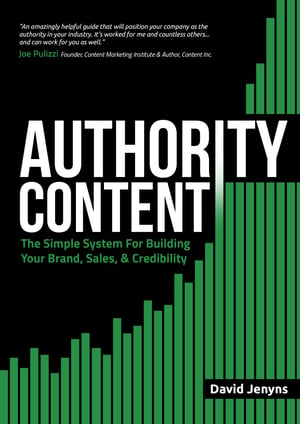
David Jenyns On Authority Content – Book Release 11th August 2016
Read how a Sydney strata lawyer used a podcast to become the obvious choice in her field: How independent professionals use a podcast to win better clients.
Then work out what one new client is worth to you: What is one client worth to you?
Short answer
David Jenyns says authority content is helpful information and stories, published again and again, so the right people notice you, engage with you and come to trust you. The aim is for people who need what you sell to raise their hand.
His process has three steps. Record a lot of content in one day in front of a small audience, turn it into a product or a free guide, then cut it into pieces and share it everywhere.
Key takeaways
- Attention, then engagement, then trust: one low-quality piece won't do it. You need good content over a long enough time for people to trust you.
- It takes months, often years: how long depends on the purchase. Someone locked out of their house picks a locksmith in 20 minutes, while a $60,000 swimming pool takes much longer.
- Answer the questions buyers ask before they buy: a domestic cleaner's "how to iron a shirt" videos drew the wrong people. Videos answering whether people should feel guilty about getting a cleaner drew the right ones.
- People can feel they know you before you meet: a Compass Pools couple had watched over two hours of the salesperson's videos. They were sure they had met him before.
- Pick a date and invite people: a booked day with a small audience forces you to record. Hand the editing and sharing to someone else.
 David Jenyns who’s the founder of authoritycontent.com. He started his career in the stockbroking industry, and he went on to build a very successful business called Melbourne SEO Services, and that’s melbourneseoservices.com. This SEO service has evolved into authoritycontent.com which is the direction in which SEO is heading given Google’s insatiable hunger for high quality”.
Related Episodes:
- 029. What Is SEO and How To Integrate It with Your Content Marketing Strategy – with David Jenyns
- 030. How to Use Frameworks to Take Your Business to the Next Level – with Taki Moore
- 075. Joe Pulizzi — Founder of Content Marketing Institute — Does Your Content Fit Into Your Buyer’s Journey?
- 073. Darren Rowse — Problogger Founder — Shares His Secrets Around Prolific Content Creation, Podcasting, & Facebook Live (Part 1 of 2)
- 074. Darren Rowse (Problogger) Shares His Blogging Success Secrets (Part 2 of 2)
- 072. Bob Burg On How To Be A Go Giver And Get Your Customer To Know Like And Trust You
- 038. Rand Fishkin – How To Create Great SEO Friendly Content Plus Key Trends In Search
- 041. Mobilegeddon Is Here! Is Your Site Mobile Responsive? – with Eric Enge
- 080. Podcast Launch Delivers 26 New Leads And 1 New Client Within 6 Weeks To A Successful Legal Practice! [Case Study]
- 006. Chris Garrett (Copyblogger) On How To Use Content Marketing To Win Online (Including A Simple 5 Day Plan To Get You Started In A Week!)
- 023. Content Marketing for Business Success
- 032. Dan Norris on his new book Content Machine (Released 10th Aug 2015)
- 015. Google Adwords Success Secrets Revealed! With Mike Rhodes
- 036. Online Presence, Key Trends In Content Marketing, And What This Means For You — With Yaro Starak
Books Mentioned

Transcript
Machine transcript, lightly edited for reading. Speakers aren't marked. The intro, plugs and closing voiceover are left out.
Today's guest is the founder of one of Australia's most trusted digital agencies, Melbourne SEO and Video. He is recognized as a high achieving entrepreneur.
And you'll find many of his keynote presentations on YouTube, including TEDx in the Netherlands, WordCamp, and Pro Blogger, which belongs to Darren Rowse, who I recently interviewed on this podcast. Now, he's recently published a book called Authority Content and has a website of the same name.
And they're showing it on the screen if you're watching it on video. I previously featured him on episode 29, where we talked about how to integrate SEO with content strategy.
And that episode was really well received. So today, I'm delighted to welcome David Jenyns from authoritycontent.com to discuss his new book.
Welcome, David. Fantastic.
Thank you for the introduction there, Ash. And I'm very pleased to be back.
It was good to hear that it was well received as well. So I'm pretty excited on the verge of this book launch.
And you snuck in an interview before that happens. So as the momentum starts to gain, so I'm very excited to share just some of the key insights that I've picked up since we last chatted.
Yeah. Wow.
I'm looking forward to that as well. So David, let's start from the beginning and let's just refresh our listeners' minds.
So let's talk about why you think Authority Content is so critical to growing a successful business and a brand today. And when does the book come out?
Well, the book comes out on the 11th of August, 2016. But the whole purpose for writing this book has a lot to do with our clients.
I work with a lot of businesses and most business owners struggle to get their message out there. They know they need to be creating great content that really captures their audience's attention, but they just don't find the time.
They're caught up in the day-to-day grind and they just can't get enough space. And then they might engage a company like ours and we start working with them.
And again, we'll work with them for a little while. We can implement things, but SEO starts to have a diminishing return after a period of time if you're not consistently putting in new, great, high quality content.
So I think where Authority Content really comes to its own and why it's so important is it is a very noisy marketplace out there. No matter what industry you're in, everybody's trying to clamor above each other to try and be heard and get their message out there about their products and their services.
So the real game for a business is to firstly make sure that they get the attention. And that's just step one.
Then they need to start to engage that audience. You can't create a little piece of content, get it out there.
You know, you do it once off and it's a low quality piece of content because that won't get them over to step number two, this level of engagement that you need. You need to be consistently putting out high quality content when someone actually stops to listen to what you've got to say, that they watch it and they go, "Oh, wow, that was really something of value.
I'm glad I spent my two, three minutes on Facebook having a look at that video or I'm glad I checked out that piece of content over on YouTube." And then if you do that consistently over a long enough period of time, that's when you start to get someone's trust and that's that final stage.
Now, how quickly does it take to get trust? Well, it depends and it really differs from every single person.
Some people can reach that level of trust much quicker with fewer engagements and maybe they're just able to pick up on someone's expertise and authority and go, "Yep, this is someone that I can trust." Others, that needs to be earned over time.
So as a business owner, you need to be creating content that catches attention and you need to have it good enough that it keeps people engaged and you need to do it over a long enough period that you build up enough trust. And once you do that, that's when it becomes a little bit of a game changer for business owners because typically speaking, authorities tend to get the lion's share of business.
People get attracted to them and sometimes or more often than not, the authority charges a premium as well. So it's not a price-based decision.
When someone makes a purchasing decision, they just want to know that they're getting good value for money and they're going to get the result that they're paying for. And being seen as an authority is a way to kind of go, "Yep, I can deliver on those promises."
Okay. So how long is long enough?
You said you need to be around for long enough. Just give us a ballpark figure of how long that is.
Yeah. Again, it really depends on things like what is the person looking to purchase?
Like for example, if I'm locked out of my house and I'm looking for an emergency locksmith, I'm looking on my mobile phone and I land on a couple of websites, I'm going to make a decision on someone's authority and whether or not they can answer my problem probably within half an hour or 20 minutes. I need that problem solved right now, which is very different from something else like buying a swimming pool, which might have a much longer buying cycle and I'm doing my research and I'm going online and it's a $60,000 purchase, then I want to make sure that I find the right person to work with.
So it's a very hard question to answer as to what the perfect timing is. Sure.
As a business owner though, the best way to think about it is business is a marathon, not a sprint. So you need to be consistently putting out content over a long period of time.
Like this is not something that I've woken up with last month and thought, "Hey, here's a great idea. I'm going to bring out this book on authority content."
This is something that I've been eating my own dog food for the past 10, 15 years and the amount of content and volumes and volumes of great quality, high engaging content that I've put out there, like it's huge. And I think as a business owner, you just need to be thinking about that long game and you just need to make it part of the way that you do business.
I really like those two examples you gave of the swimming pool and being locked out of your house that really nailed it for me and I completely agree. It is a case of how long is a piece of string.
It really varies as to how long you should be online to develop authority. But here's one thing I would say to the listeners, if you're expecting to do this in weeks, then think again because you're looking at at least months, if not years before you start really developing authority.
And again, to come back to your earlier point, David, consistent high value content, that is the key. That brings us to the next question very nicely.
It segues in the next question. How would you define authority content in the context of the three P's you talked about in our last episode?
So you talked about present, product and promote. Just talk us through that and how that fits into your content strategy.
Yeah. So to make sure I get the wording just right, let me do a little book reading for you.
I've got the exact definition of authority content, which is authority content is the act of consistently creating and distributing helpful information and stories to gain attention, engagement and trust for a clearly defined audience with the objective of identifying those who will benefit from your products and services. Wow.
What a huge mouthful. You heard it here first, people.
This is the first time I bet that's been read out of the book, right, David? Yep.
This is a world first. Yep.
This is cutting edge and you were here at that moment. You can tell your grandkids.
So if I unpack it a little bit, it's about creating high value, helpful content consistently. So you have to do it over a period of time.
And the whole purpose of creating it is to get that attention I was talking about, get the engagement and then build the trust. And it's for a very clearly defined target audience.
So you know who you're selling your products and services to. And the whole objective is to get those people who are interested in your products and services almost to self-select themselves, to raise their hand effectively and say, yes, I'm interested in what it is that you have to say, and I want to find out more.
So that's kind of what authority content is as I've defined it and where it fits in with the three P's, present, product and promote. So authority content also is a way for, well, how do you do this?
It's a system, it's a process. And I do it by following these three P's.
And this probably comes from close to seven to 10 years worth of testing on myself and also clients. And I find that most business owners, as I said before, they don't have time to create content.
So the first P present is all about batching the content creation. How can you create as much content as you can in one day?
So you do all of the pre-thinking and planning upfront. You think about what are the frequently asked questions, what are the core messages you want to get across in your videos?
What is your target market looking for? And you do all of that thinking upfront, and then you pick one day and it's like drawing a line in the sand.
You say, on this day, I will be recording all of this high value content. Now, it might be the business owner.
It could be some of the staff you might get some experts in. It doesn't really matter as long as you've got a very clear vision of the type of content that you're creating.
And by putting it on one day, you force yourself to create that because we've got a video production company and I see it all the time. People book out our video studio and they'll book in for a half day or a full day.
And it's just them in the studio with the cameraman and they'll just go over the script over and over and over and over again. At the end of a day, they might have created one video, two videos.
And that's because they're trying to just make it just right and just perfect. The problem with that is when you're going for this authority building play, you need to do it in mass.
You can't be doing that every single day. So what we suggest is by picking this one day, getting a small audience together and presenting to them, maybe it's some staff members, friends, family, just someone that means you have to do it in one take.
And that forces you to create 35, 40 videos all in one day. And that very first step is critical because it can set you up for the next three or six months worth of content because we can take that video content and then repurpose it in lots of different ways.
So it starts off by recording. That's the present phase.
And just one key I want to point out is... Yeah, please.
Taki Moore interviewed earlier on as well, says it's always good to have a person in the room when you're presenting because it really creates more of an urgency and brings more agency to the situation and you're more likely to really express yourself well. So having a physical live audience in the room is a good idea.
And this would be another reason to go and do it in a studio rather than doing it at home in front of a blank white wall. Yeah.
There's a different level of energy when you're talking to someone rather than just that empty room. And it's like you're talking to someone then or you actually are talking to someone.
So you can really think in terms of how can I help this person move forward? So it's a much different dynamic.
It comes through on the video and it also helps with the expert positioning depending on how you frame the camera and you've got a few heads, you know, the backs of heads in the frame with the camera shot. Then you take the role of more of an educator and a teacher, which is more of an authoritative role, which is a much better stance.
So having that audience also helps with that as well. So there's lots of different benefits and sometimes you don't actually appreciate the benefits until you do it.
There's a lot of unintended benefits that happen from going through this process. Then you take that content and you turn it into the second P, which is a product.
Now, depending on the business, this kind of goes back to the example we talked about earlier, you might make it a product that you sell on your website or you bonus in with your services, or it might be something that you have as an open resource on the website. So if I use the swimming pool manufacturer again, Compass Pools is one we'll talk about a little bit later.
They're a really great example. You're not going to sell a $15 ebook on how to build your own swimming pool.
That's not really useful and not a very smart front end marketing strategy. So what we did for them is we made it more of an open resource.
So it was a buyer's guide for how to buy a swimming pool and all of the right questions to ask. How long does a swimming pool take to build?
How much does a swimming pool cost? What are my different shaping options, which is better fiber, glass or concrete?
These are all of the questions that we could build into this open resource guide that lives on their website and becomes a very helpful tool in selling, but also is a fantastic magnet for the search engines and getting traffic to it. Whereas that might be a little bit different from someone like Andrew Griffiths, who we worked with.
He's a professional speaker, author, coach. He teaches people how to write books, those sorts of things.
And we recorded one of his workshops, which was the business of professional speaking. And we turned that into a saleable product that he sells for $400 and bundles in with some of the different courses that he does.
So it depends. You do a little bit of thinking about what you do with that content once you create it.
And then the final step, which is the promote phase, you then take that content and you chop it up into pieces. Now, the way that you chop it up into pieces, this comes from a lot of experience from what we've done with search engine optimization.
We can start off with the video content. We can split out the audio.
We can get the video transcribed. Now we've already got three different modes.
That content can then be repurposed further. You can take the transcript and pass it to a ghost writer.
And that ghost writer can turn it into a high quality article. And we can take the videos that get chopped up into little pieces and uploaded to YouTube and then embed them on your website as blog posts.
We can take the transcripts and post them on PDF sharing sites. We can take the audios and share it through things like iTunes or SoundCloud.
There's just so many different ways that you can share this content. And every piece of content that you share, you fully optimize.
And then you start to syndicate some of the best bits across your social media and email out your database. There's a whole process and system that happens as part of this backend syndication that just creates a traffic storm.
Do you syndicate through things like Buffer or any particular tool you recommend? The way that I do it, we've built up a bit of a virtual team.
So for ourselves and also our clients, we actually do most of it by hand. Part of the reason for that is we want to make sure that every piece is unique.
Sometimes when people use Buffer, they'll have the same post and they'll push it out to every single platform and Twitter, Facebook, Google Plus. And every time it gets posted out, it says exactly the same thing and it's not tailored for the platform.
Yet every social media platform is a little bit different and you need to understand the little idiosyncrasies of each platform and tailor it for those platforms. So me being the systems guy, we've pretty much broken this whole process down into detailed step-by-step processes that then our team executes.
And it is something that the business owner, all they need to focus on is that step one, the present phase. Once they create all of that great content and they present, everything else afterwards can actually be outsourced and delivered by your team.
So that's the real key here. It's about creating mass amount of content and getting it syndicated without having the business owner really just spending hours on hours trying to get this content out there.
So the three phases were we've got the present that we talked about, capturing it. Then we've got the product, which is putting it on the side or selling it as a product.
And then the final one, which is the promote, it's that syndication phase. And that's where we chop it up and start to share it around.
Cool. Okay.
There's a few points I want to make about content that are relevant here that we haven't covered yet. One was something that Joe Pulizzi, the founder of the Content Marketing Institute, I talked to him on episode 75.
And I really loved what he said about creating content that meets your audience where they are rather than creating content around your product. I really liked that because we don't think enough from the perspective of our audience, of our target audience.
And if you meet your audience where they are, rather than trying to shove your content that is related to your product down their throats when they're not ready for it, you're less likely to convert. Just before you jump to that other point, I want to really underscore that one as well.
Not only is it about creating the content and then putting it in the right places, it's also understanding the audience and creating the content. Joe might have been also talking about creating the content for where their mind is.
Yes. A really good example of that is, so we started working with a domestic cleaner who has gone through the authority content process, and they'd already created some content before they started working with us.
And they were creating videos around how to clean the grout in your shower and how to iron the perfect shirt and those sorts of things. And when we started working with them, I said, look, the content that you're creating here, it's not going to be attracting in your target audience.
The person searching on YouTube for how to iron the perfect shirt isn't the person thinking, hey, I want to hire a domestic cleaner. So when we went in and applied authority content for them, we flipped it on its head and we started to answer questions like, should I feel guilty about getting a cleaner?
How do I prepare my house before a cleaner comes? How do I know how long a cleaner needs to come to my house?
These are the questions that people are asking prior to them making a purchasing decision and it's getting the right person. So you hit the nail on the head before, it's really important to be creating the right content.
And I can't help myself. Joe Pulizzi, he's our lead testimonial.
Awesome. So an amazingly helpful guide that'll position your company as the authority in the industry.
It's worked for me and countless others and it can work for you as well. Joe Pulizzi.
Fantastic. Well, congratulations.
He's somebody I really respect. Another point I wanted to make was what Darren Rowse said, and I really liked this.
I talked to him on episode 73 and 74, I think it was, he said, talked about having a before avatar and an after avatar for your audience. So he's all about creating content that takes your audience on a journey.
So you need to think about where your audience is before they interact with your content and where you want them to end up after they interact with your content and your content maps that path. And I really liked that approach.
Both of these approaches very much force you to think about things from your audience's perspective. And I can't underscore that enough when it comes to content creation.
I also really liked your pool example where you were helping the people solve problems with your content with that resource guide where you're saying to them, okay, what kind of a pool do I want? What kind of pools are there?
Because a lot of people don't know what they don't know. And that resource guide is giving them what they don't know as a framework to make decisions.
And so they're going to automatically assign you with being the authority in the field if you're giving them that framework that they didn't previously have. Perfect.
You hit the nail on the head there. And the Compass Pools is a really good example of that as well.
I can take you through a little bit of that case study. Well, I was going to ask you about that next.
Can you take us through a case study where your content really helped the business? Yeah, well, the Compass Pools one, they're one of Australia's leading pool manufacturers and they approach us to apply authority content for their business.
They're already an established business. They're already doing really quite well.
And we were able to, I suppose, supercharge what they were doing. So some of the results we've got, we're getting some fantastic stories from the actual application of it.
And some things I wasn't even expecting. One of the best ones comes from their lead salesperson, David Payne.
And he was telling me he went in probably about a month after they implemented authority content, he went to go visit a prospect, got to their house and husband and wife opened the door and said, "Oh, it's great to see you again, David. Come in."
And in the back of his head, he's thinking, "I don't know this person." He didn't want to say anything.
He goes in and probably about 20 minutes later, the wife's referencing things that he said and that it was great to see him again. And he thought, "I'm going to have to say something now.
Otherwise, it's going to be really awkward when she finds out we've never actually met before." So he asked politely.
He said, "Have we met before?" And both the wife and the husband were emphatic.
They were like, "Yep, we've met before." He said, "We've definitely caught up."
And he's thinking, "Okay, well, maybe I just need to agree to disagree." And about an hour later, the husband goes, "I know how I know you.
We've watched, you're the guy from the Compass Pools videos. We've watched over two hours of your videos before you ever step foot in our house.
That's how we feel like we know you." Now, that completely changes the buyer's dynamic where they felt like they knew him before he'd ever actually met them.
You can just imagine that authority positioning that gives him. Totally.
And that's just... Authority content isn't just about creating videos.
It's not a video strategy. There's so much more that comes from improving of conversion and generating traffic.
It's the whole thing. There's lots of different stories.
I just love that one because he's a great salesman. He probably would have sold them anyway, but it just completely put him on the front foot and seen as that expert.
And the know, like, and trust thing as well, right? I reckon podcasts and videos.
It's the same thing. It's the way to connect with someone, but do it en masse.
So that way you already have a little bit of a relationship by the time someone starts to chat with you. They kind of already get a feeling like they know who you are, which is great because when you do finally chat with them and then your actual personality is the same as what they hear on the podcast or the videos, that just reinforces at a deeper level.
So it's really important when you create that content that you just be natural and authentic and know your subject matter and be helpful. And that really comes through.
And then when people actually chat with you, they're like, oh, wow, you know, this story's congruent. It just keeps following all the way through.
Yes, absolutely. And that also increases the likelihood of them wanting to share your content with other people if it's useful and they feel that sense of trust.
And that was actually something Rand Fishkin kept talking about when I interviewed him. I think that was episode 38 or something, but he kept saying the kind of content that gets shared actually creates the best quality SEO results.
Yeah, 100 percent. Because SEO happens naturally when people are liking the content and they're sharing it, engaging in it socially, passing it around to their friends.
Someone will pick it up and say, oh, that's quite good. And they'll post it on their blog or it gets mentioned in a comment.
And all of that then becomes the signals that Google picks up on. They see these shares and the engagements and the links.
When someone tries to manipulate the search engine rankings and really tries to generate backlinks, they're just trying to replicate what happens in nature. So if you think about it logically and you're creating great content, you can have great SEO.
There's still a little bit of SEO you need a layer over the top. It's good to think about the keywords and put them in the title and the description, but you don't need to hit it with a hammer like you used to.
People used to think, ah, SEO, bring, bang, bang, bang, bang, bang, bang, bang, bang. Whereas now, SEO, you do it much more subtly.
It's about creating great content and still priming it and prepping it. And Rand knows his stuff inside of it.
It's very organic these days. SEO is about creating organic stuff that people want to share.
And let's face it, the kind of content we want to share is not just good quality content, but also content from people we like and know and trust. And that's the whole point about consistent good quality content, which comes back to your earlier point about consistency.
I might chime in as well. If you think about what Google's trying to do, Google wants to give the best user experience for people when they come to the search engines.
They want someone to go to Google, type in a question, and very quickly find their answer. Now, if someone lands on a page and hits the back button because it's very low quality content or not engaging, or if someone doesn't even click on a result, do you think that sends a good signal to Google?
Of course not. Absolutely not.
Google is monitoring what users are doing. So optimizing for the user is the best way to future-proof any SEO strategy because it's all about thinking, "How can I create something that's useful?"
Because that's aligning your objectives with Google's objectives, so you're going to get a great result. And Google's core competency in this case is search.
And if they don't provide the best quality search, in other words, if they aren't the best in class or best in the world for their core competency, they are going to start getting beaten out by the competition. So obviously, Google has to make sure that you have a superlative experience.
Eric Enge and Rand Fishkin both talked about this, and I totally agree with that point. So what are the biggest challenges you've noticed with getting started with authority content?
I suspect getting started is one of the biggest challenges. And what's the best way to overcome it?
Yeah. Look, I think oftentimes if people look for excuses not to do something, they'll find it.
There's plenty of excuses. Why not?
Oh, I don't think I can present in front of the camera. I don't think I have the right equipment.
I don't have the right technical knowledge. What do I know about my products and services?
Like if you look for excuses, you'll find them. But on the flip side, if you look for reasons to do something, then you'll find those too.
The fact is, video is still exploding. Most of your competition won't get in front of the camera.
So it's a very quick way to stand out from the competition. And the benefits are numerous.
Not only will it help with conversion, but it also help with traffic and there's this trickle down effect and it helps position you as the authority. So I think firstly, like you said, just getting started is the first biggest thing.
So I always recommend once someone starts thinking about this idea of authority content, you really just need to pick a day and you need to start inviting people because nothing will motivate you more than thinking, hey, I'm going to have a room of five, 10, 15, 20 people in the room all ready to hear me talk about this content. It forces you to create it.
So I used to have this friend actually, and it's called like a positive constraint where he used to sleep in the morning. So what he did, he started parking his car out the front of his house in a clear way zone because he knew if he didn't get up at six in the morning, they would tow his car.
So it was a forced constraint on himself to get up and move the car. And I see picking a date as that same thing.
The other thing I see people do is they get caught up in the tech and they want to solve all of these problems themselves. They're thinking, what's the right camera?
You know, the editing is going to just take so much time. You know, which piece of editing software am I going to use?
All those sorts of things which can very easily be solved. Certain things you should focus on as a business owner and other things you shouldn't.
So I think you need to focus on serving your clients. You need to focus on building up your authority.
You don't need to focus on editing a video and spending the next five days in Final Cut Pro. Go to a university, find a final year student and say, hey, you want to build up your portfolio, come and work with me for a day and I'll pay you $15 an hour, $20 an hour.
That's a much better way to solve that problem than to try and think you need to solve it yourself. So I think to overcome, just pick a day and anything where you get really, really stuck, then try and outsource it or find someone who can help implement it.
And as long as you've got a good strategy, that's the biggest thing. I mean, that's what authority content is all about.
It's the strategy. If you took this book, you read it and then you handed it to maybe a marketing intern or something like that and you said, all right, your job for the next six months is to apply authority content in our business.
I think that would probably be the best, however much it costs you to get an intern for the year. You know, the best 30 grand you spend over the next 12 months.
So it's how can you just focus on what you're best at? Okay.
Well, for someone who's been very reluctant to get in front of the camera myself, I actually have got a positive constraint that has inadvertently been put in place. My client and friend Amanda Farmer has been speaking at Macquarie Bank in September.
So I love it.